




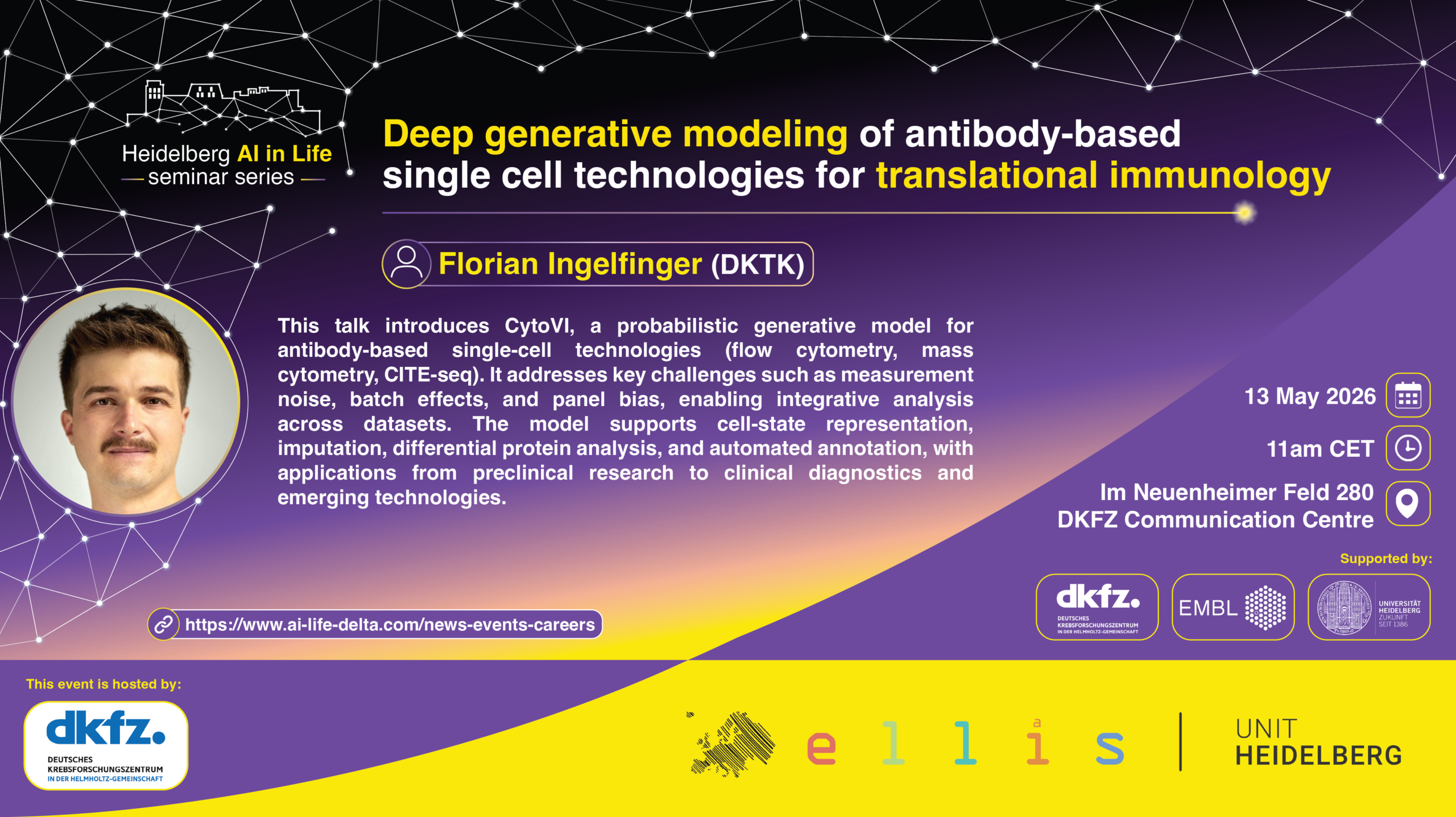
Florian Ingelfinger's talk will focus on generative models for antibody-based single-cell technologies such as flow cytometry, mass cytometry, and CITE-seq. These platforms are widely used to study immune cell states, but their analysis is often complicated by measurement noise, batch effects, platform-specific biases, and limited or only partially overlapping antibody panels. Together, these challenges make it difficult to integrate datasets and build knowledge across studies and technologies.
Florian will present CytoVI, a probabilistic generative model developed to address these limitations and enable rigorous, integrative analysis of antibody-based single-cell data. He will highlight how such models can support key tasks including cell-state representation, imputation of missing measurements, differential protein expression analysis, and automated cell annotation.
The talk will explore how these approaches can advance preclinical discovery and support clinical applications, including the diagnosis of hematological malignancies. Finally, Florian will give an outlook on emerging antibody-based single-cell technologies, including nanoscale protein interactomics, and discuss how probabilistic modeling may help study cellular processes such as immune synapse formation.